Why it matters
This part of the post feature helps users move from simple publishing to real social interaction.
The Zent-ic post feature helps users share ideas, updates, questions and announcements. A post can lead to replies, profile discovery, community participation and direct messages.
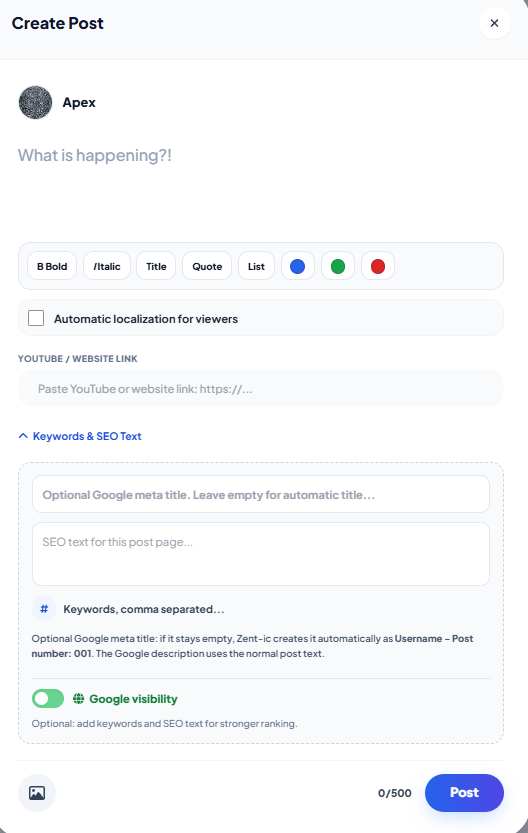
The post feature is one of the most important parts of Zent-ic because it gives the social network a public voice. A user can open the platform, publish an idea, share an update, ask a question, start a discussion or invite people into a community. Without posts, a social network feels silent. With posts, the platform becomes discoverable, active and alive.
A professional post feature should not be explained as only a simple text box. It is the start of a social journey. A post can lead to replies. Replies can lead to profile visits. A profile can lead to a community. A community can lead to direct messages. That is why the Zent-ic post feature should be presented as the beginning of connection, not only as a publishing tool.
This page is built for the slug https://zent-ic.com/feature-post and focuses on one feature: public posts. It uses only one image, post.png, and the rest of the meaning is written as real HTML text so visitors and search engines can understand the page clearly.
This part of the post feature helps users move from simple publishing to real social interaction.
The benefit is a clearer path from expression to replies, discovery, profile visits, communities and direct messages.
The section uses natural language and avoids keyword stuffing, hidden text or fake ranking promises.
Public posts allow users to participate without needing to create a complex page or community first. A user can write a short update, publish a thought, ask for feedback or share something useful. That low barrier matters because people are more likely to return when participation feels simple.
The public layer also helps the network grow. When posts are visible, people can discover new voices, new topics and new profiles. A platform that hides all conversation inside private spaces is harder to understand from the outside. Public posts create signals that the network is active.
Zent-ic can use posts as the foundation for social discovery. A post can be a small moment, a helpful answer, an announcement, a creator update or the beginning of a long conversation.
This part of the post feature helps users move from simple publishing to real social interaction.
The benefit is a clearer path from expression to replies, discovery, profile visits, communities and direct messages.
The section uses natural language and avoids keyword stuffing, hidden text or fake ranking promises.
A strong post feature should support many real use cases. Some users want quick posts. Others need longer explanations. Creators may need audience updates. Communities may need announcements. Students may need questions and answers. Small brands may need trust-building posts that explain services or products.
The page should explain these use cases in normal language, not as a keyword list. This helps users understand the feature and helps search engines understand the topic depth without spam.
The most important idea is flexibility. A post should be simple enough for everyday updates and strong enough for creators, communities and projects.
This part of the post feature helps users move from simple publishing to real social interaction.
The benefit is a clearer path from expression to replies, discovery, profile visits, communities and direct messages.
The section uses natural language and avoids keyword stuffing, hidden text or fake ranking promises.
A public post becomes more valuable when people can reply. Replies turn a broadcast into a discussion. They help the author understand how people react and allow the audience to add context, ask questions or bring new perspectives.
For Zent-ic, the post feature should be connected to comments and discussion. If a post is interesting, users should be able to stay near the topic instead of losing the conversation in a separate app or disconnected chat.
Good discussion design makes posts feel alive. It also helps communities and creators because useful replies can become part of the content itself.
This part of the post feature helps users move from simple publishing to real social interaction.
The benefit is a clearer path from expression to replies, discovery, profile visits, communities and direct messages.
The section uses natural language and avoids keyword stuffing, hidden text or fake ranking promises.
A post is easier to trust when the reader can understand who wrote it. This is why profiles matter. A post should connect to a visible identity, allowing visitors to open the profile, read more and decide whether the author is relevant to them.
For everyday users, this creates recognition. For creators, it builds a public presence. For small projects, it creates trust. For communities, it helps people understand who is active and what they contribute.
The relationship between posts and profiles is one of the strongest reasons to build a complete social network instead of a simple feed.
This part of the post feature helps users move from simple publishing to real social interaction.
The benefit is a clearer path from expression to replies, discovery, profile visits, communities and direct messages.
The section uses natural language and avoids keyword stuffing, hidden text or fake ranking promises.
Many public posts naturally belong to a larger topic. A gaming post may belong in a gaming community. A travel question may belong in a travel community. A study explanation may belong in a learning group. A creator update may belong in a creator community.
Zent-ic communities give posts a place to continue. Instead of disappearing after a short moment of attention, a post can help build an ongoing topic space.
This makes the post feature more useful for long-term growth. Communities create structure, and posts create activity inside that structure.
This part of the post feature helps users move from simple publishing to real social interaction.
The benefit is a clearer path from expression to replies, discovery, profile visits, communities and direct messages.
The section uses natural language and avoids keyword stuffing, hidden text or fake ranking promises.
Not every conversation should stay public. Some questions need more detail. Some collaborations need a private follow-up. Some users prefer direct communication after a public first contact.
The Zent-ic post feature becomes stronger when it can lead naturally into chat. A person sees a post, replies, opens the profile and then sends a direct message when it makes sense.
This flow matters because it connects public discovery with private connection. It makes the social network feel complete.
This part of the post feature helps users move from simple publishing to real social interaction.
The benefit is a clearer path from expression to replies, discovery, profile visits, communities and direct messages.
The section uses natural language and avoids keyword stuffing, hidden text or fake ranking promises.
Creators often need to explain ideas, publish updates, ask for feedback and guide their audience toward deeper conversations. A visual post alone is not always enough. Written posts can carry context, meaning and direction.
Zent-ic posts can help creators share behind-the-scenes updates, announce projects, answer frequently asked questions, start discussions and invite people into communities.
The creator value is simple: posts create public visibility, profiles create identity, communities create audience structure and chat creates direct communication.
This part of the post feature helps users move from simple publishing to real social interaction.
The benefit is a clearer path from expression to replies, discovery, profile visits, communities and direct messages.
The section uses natural language and avoids keyword stuffing, hidden text or fake ranking promises.
A small brand does not always need a complicated campaign. Sometimes it needs a simple public update that people can understand. A service provider can explain what is new. A local shop can post an announcement. A travel page can answer questions. A coach can publish a short lesson.
Posts help small brands communicate in a human way. They create public proof of activity and give customers a place to ask follow-up questions.
For a growing platform like Zent-ic, this use case is important because small brands and local projects can become active content sources.
This part of the post feature helps users move from simple publishing to real social interaction.
The benefit is a clearer path from expression to replies, discovery, profile visits, communities and direct messages.
The section uses natural language and avoids keyword stuffing, hidden text or fake ranking promises.
Learning often begins with a question. A student may want to ask about a topic, share an explanation or collect answers from other users. A post gives that question a visible place.
Study groups can use posts for exam preparation, language practice, homework discussions and resource sharing. Communities can organize these topics while posts keep the activity visible.
This makes the post feature useful beyond entertainment. It can support real learning and knowledge exchange.
This part of the post feature helps users move from simple publishing to real social interaction.
The benefit is a clearer path from expression to replies, discovery, profile visits, communities and direct messages.
The section uses natural language and avoids keyword stuffing, hidden text or fake ranking promises.
Local communities often need practical communication. People may ask for recommendations, share events, discuss places or announce local updates. Posts are a simple format for this.
A local post can be understood quickly and replied to directly. If the topic grows, it can move into a community. If someone needs more information, the conversation can continue in chat.
This local use case helps show that Zent-ic posts are not only for influencers or public figures. They can support everyday community life.
This part of the post feature helps users move from simple publishing to real social interaction.
The benefit is a clearer path from expression to replies, discovery, profile visits, communities and direct messages.
The section uses natural language and avoids keyword stuffing, hidden text or fake ranking promises.
Public posts can reach more people when language is less of a barrier. If a post can be translated or understood by international users, the conversation can move beyond one country or language group.
This matters for travel topics, culture, gaming, language learning, international creators and global communities. A post can introduce an idea, while translation can help more people understand it.
The post feature therefore works closely with the translation feature. A social network becomes more global when posts and discussions can cross language borders.
This part of the post feature helps users move from simple publishing to real social interaction.
The benefit is a clearer path from expression to replies, discovery, profile visits, communities and direct messages.
The section uses natural language and avoids keyword stuffing, hidden text or fake ranking promises.
A professional post feature should encourage readable content. Posts should be easy to understand and structured enough to create meaningful replies. Users should not feel forced to post only short noise or shallow reactions.
Readable posts are also better for search, sharing and accessibility. Real HTML text is easier to crawl, copy, translate and read with assistive technologies.
This page is written with the same principle. It does not hide text inside images or keyword blocks. It explains the feature clearly in visible content.
This part of the post feature helps users move from simple publishing to real social interaction.
The benefit is a clearer path from expression to replies, discovery, profile visits, communities and direct messages.
The section uses natural language and avoids keyword stuffing, hidden text or fake ranking promises.
Any platform with public posts needs responsible moderation. The stronger the public layer becomes, the more important it is to have clear rules, reporting tools and community control.
A professional feature page should not ignore this. Posts can create discussion, but the platform should also help reduce abuse, spam and harmful behavior.
Zent-ic can present public posting as a useful feature while still making trust, safety and community quality part of the message.
This part of the post feature helps users move from simple publishing to real social interaction.
The benefit is a clearer path from expression to replies, discovery, profile visits, communities and direct messages.
The section uses natural language and avoids keyword stuffing, hidden text or fake ranking promises.
Many users will write posts from a phone. The interface should therefore feel fast, clear and comfortable on small screens. A post button should be easy to find, text should be readable and the publishing flow should not feel heavy.
The feature page itself is also designed to be mobile-friendly. The layout stacks cleanly, the header remains compact and the call-to-action buttons stay tap-friendly.
A mobile-first post feature helps users participate more often because they can share ideas when they happen.
This part of the post feature helps users move from simple publishing to real social interaction.
The benefit is a clearer path from expression to replies, discovery, profile visits, communities and direct messages.
The section uses natural language and avoids keyword stuffing, hidden text or fake ranking promises.
The page includes important terms such as Zent-ic post feature, public posts, social posts, post discovery, creator posts, community posts and social network posts. They appear inside real explanations instead of a keyword-stuffed list.
There is no meta keywords tag, no hidden heading, no invisible text and no fake keyword glossary. The page is built around useful sections, internal links, image alt text and structured FAQ data.
That is the safer strategy for long-term SEO because the page helps both users and search engines understand the feature.
This part of the post feature helps users move from simple publishing to real social interaction.
The benefit is a clearer path from expression to replies, discovery, profile visits, communities and direct messages.
The section uses natural language and avoids keyword stuffing, hidden text or fake ranking promises.
Use the slug /feature-post and keep the canonical URL as https://zent-ic.com/feature-post. If an older file path exists, redirect it to the clean slug.
Place post.png in the same public directory as this HTML file or adjust the image path if your hosting structure is different. The page intentionally uses only post.png as the feature image.
Add the page to the sitemap, link it from /features, and keep internal links to related pages such as /feature-chat, /social-network, /what and /why-zent-ic.
This part of the post feature helps users move from simple publishing to real social interaction.
The benefit is a clearer path from expression to replies, discovery, profile visits, communities and direct messages.
The section uses natural language and avoids keyword stuffing, hidden text or fake ranking promises.
Public posts are flexible because different users can use the same feature for different goals.
A user publishes a short public thought, receives replies and discovers people with similar interests.
A creator publishes an update, explains a project and guides interested followers into a community.
An admin posts announcements, rules, weekly topics and discussion starters for members.
A student asks a question, receives replies and continues in a learning community.
A small brand shares updates, answers customer questions and builds trust with visible activity.
A local group posts about events, recommendations and practical community topics.
A user discovers posts from other languages and can understand more through the translation layer.
A visitor reads a public post, opens the profile behind it and decides whether to join the platform.
A post feature should feel simple on the surface and powerful in the way it connects with the rest of the social network.
A post should be written in a way that people can understand quickly. Clear writing creates better replies and better social discovery.
A post becomes more trustworthy when readers can open the profile behind it and understand the person or project.
A post should invite replies and help the conversation continue without forcing users to leave the platform.
Posts can become the activity layer inside communities, helping members follow updates and shared topics.
Posting should work well on phones because many real social moments happen while users are away from a desktop.
A public post feature needs moderation, reporting and community rules so useful conversations can grow.
Posts become more valuable when international users can understand them through translation and clear context.
A professional feature page should explain the product with visible text and natural language, not hidden keyword blocks.
This library keeps the page useful and gives visitors concrete examples without turning the text into a keyword list.
Use announcement posts when a creator, community or small brand needs to share a clear update. A good announcement should explain what changed, why it matters and what the reader can do next.
Use question posts to invite replies. A useful question is specific enough for people to answer but open enough to create conversation.
Use educational posts for explanations, lessons, study notes and helpful resources. These posts are valuable because they can continue to help readers after the first moment of publication.
Use feedback posts when the author wants opinions, suggestions or corrections. Feedback posts can help creators, projects and communities improve.
Use community prompts to keep a group active. A weekly topic, a simple question or a shared challenge can give members a reason to return.
Use local updates for events, recommendations, changes and community notices. Local posts can be practical and easy to discuss.
Use creator updates to explain progress, announce new work, ask for audience input or invite followers into a community.
Use project notes to share progress, decisions, roadmaps and lessons learned. This can help a project build trust over time.
These guidelines explain how users can write stronger posts without forcing the page into spammy repetition.
A useful Zent-ic post should be clear, honest and connected to a real conversation goal. It can inform, ask, explain, invite, announce or help. The best posts give readers enough context to reply meaningfully and understand the profile or community behind the message.
A useful Zent-ic post should be clear, honest and connected to a real conversation goal. It can inform, ask, explain, invite, announce or help. The best posts give readers enough context to reply meaningfully and understand the profile or community behind the message.
A useful Zent-ic post should be clear, honest and connected to a real conversation goal. It can inform, ask, explain, invite, announce or help. The best posts give readers enough context to reply meaningfully and understand the profile or community behind the message.
A useful Zent-ic post should be clear, honest and connected to a real conversation goal. It can inform, ask, explain, invite, announce or help. The best posts give readers enough context to reply meaningfully and understand the profile or community behind the message.
A useful Zent-ic post should be clear, honest and connected to a real conversation goal. It can inform, ask, explain, invite, announce or help. The best posts give readers enough context to reply meaningfully and understand the profile or community behind the message.
A useful Zent-ic post should be clear, honest and connected to a real conversation goal. It can inform, ask, explain, invite, announce or help. The best posts give readers enough context to reply meaningfully and understand the profile or community behind the message.
A useful Zent-ic post should be clear, honest and connected to a real conversation goal. It can inform, ask, explain, invite, announce or help. The best posts give readers enough context to reply meaningfully and understand the profile or community behind the message.
A useful Zent-ic post should be clear, honest and connected to a real conversation goal. It can inform, ask, explain, invite, announce or help. The best posts give readers enough context to reply meaningfully and understand the profile or community behind the message.
A useful Zent-ic post should be clear, honest and connected to a real conversation goal. It can inform, ask, explain, invite, announce or help. The best posts give readers enough context to reply meaningfully and understand the profile or community behind the message.
A useful Zent-ic post should be clear, honest and connected to a real conversation goal. It can inform, ask, explain, invite, announce or help. The best posts give readers enough context to reply meaningfully and understand the profile or community behind the message.
A useful Zent-ic post should be clear, honest and connected to a real conversation goal. It can inform, ask, explain, invite, announce or help. The best posts give readers enough context to reply meaningfully and understand the profile or community behind the message.
A useful Zent-ic post should be clear, honest and connected to a real conversation goal. It can inform, ask, explain, invite, announce or help. The best posts give readers enough context to reply meaningfully and understand the profile or community behind the message.
This handbook adds practical, visible content for users. It is not hidden text and does not repeat empty keywords.
The connection between posts and profiles is important because people rarely trust isolated content. A reader should be able to open the profile behind a post and understand the broader context. The connection between posts and communities is important because a useful topic often deserves a place to continue. A community can keep discussions organized over time. The connection between posts and chat is important because some public conversations naturally become private. A direct message can continue the topic with more detail.
The connection between posts and communities is important because a useful topic often deserves a place to continue. A community can keep discussions organized over time. The connection between posts and chat is important because some public conversations naturally become private. A direct message can continue the topic with more detail. A public post should have a clear reason to exist. The reason may be to inform, ask, explain, invite, update or begin a discussion. When the reason is clear, readers understand how to respond.
The connection between posts and chat is important because some public conversations naturally become private. A direct message can continue the topic with more detail. A public post should have a clear reason to exist. The reason may be to inform, ask, explain, invite, update or begin a discussion. When the reason is clear, readers understand how to respond. The connection between posts and profiles is important because people rarely trust isolated content. A reader should be able to open the profile behind a post and understand the broader context.
A public post should have a clear reason to exist. The reason may be to inform, ask, explain, invite, update or begin a discussion. When the reason is clear, readers understand how to respond. The connection between posts and profiles is important because people rarely trust isolated content. A reader should be able to open the profile behind a post and understand the broader context. The connection between posts and communities is important because a useful topic often deserves a place to continue. A community can keep discussions organized over time.
The connection between posts and profiles is important because people rarely trust isolated content. A reader should be able to open the profile behind a post and understand the broader context. The connection between posts and communities is important because a useful topic often deserves a place to continue. A community can keep discussions organized over time. The connection between posts and chat is important because some public conversations naturally become private. A direct message can continue the topic with more detail.
The connection between posts and communities is important because a useful topic often deserves a place to continue. A community can keep discussions organized over time. The connection between posts and chat is important because some public conversations naturally become private. A direct message can continue the topic with more detail. A public post should have a clear reason to exist. The reason may be to inform, ask, explain, invite, update or begin a discussion. When the reason is clear, readers understand how to respond.
The connection between posts and chat is important because some public conversations naturally become private. A direct message can continue the topic with more detail. A public post should have a clear reason to exist. The reason may be to inform, ask, explain, invite, update or begin a discussion. When the reason is clear, readers understand how to respond. The connection between posts and profiles is important because people rarely trust isolated content. A reader should be able to open the profile behind a post and understand the broader context.
A public post should have a clear reason to exist. The reason may be to inform, ask, explain, invite, update or begin a discussion. When the reason is clear, readers understand how to respond. The connection between posts and profiles is important because people rarely trust isolated content. A reader should be able to open the profile behind a post and understand the broader context. The connection between posts and communities is important because a useful topic often deserves a place to continue. A community can keep discussions organized over time.
The connection between posts and profiles is important because people rarely trust isolated content. A reader should be able to open the profile behind a post and understand the broader context. The connection between posts and communities is important because a useful topic often deserves a place to continue. A community can keep discussions organized over time. The connection between posts and chat is important because some public conversations naturally become private. A direct message can continue the topic with more detail.
The connection between posts and communities is important because a useful topic often deserves a place to continue. A community can keep discussions organized over time. The connection between posts and chat is important because some public conversations naturally become private. A direct message can continue the topic with more detail. A public post should have a clear reason to exist. The reason may be to inform, ask, explain, invite, update or begin a discussion. When the reason is clear, readers understand how to respond.
The connection between posts and chat is important because some public conversations naturally become private. A direct message can continue the topic with more detail. A public post should have a clear reason to exist. The reason may be to inform, ask, explain, invite, update or begin a discussion. When the reason is clear, readers understand how to respond. The connection between posts and profiles is important because people rarely trust isolated content. A reader should be able to open the profile behind a post and understand the broader context.
A public post should have a clear reason to exist. The reason may be to inform, ask, explain, invite, update or begin a discussion. When the reason is clear, readers understand how to respond. The connection between posts and profiles is important because people rarely trust isolated content. A reader should be able to open the profile behind a post and understand the broader context. The connection between posts and communities is important because a useful topic often deserves a place to continue. A community can keep discussions organized over time.
The connection between posts and profiles is important because people rarely trust isolated content. A reader should be able to open the profile behind a post and understand the broader context. The connection between posts and communities is important because a useful topic often deserves a place to continue. A community can keep discussions organized over time. The connection between posts and chat is important because some public conversations naturally become private. A direct message can continue the topic with more detail.
The connection between posts and communities is important because a useful topic often deserves a place to continue. A community can keep discussions organized over time. The connection between posts and chat is important because some public conversations naturally become private. A direct message can continue the topic with more detail. A public post should have a clear reason to exist. The reason may be to inform, ask, explain, invite, update or begin a discussion. When the reason is clear, readers understand how to respond.
The connection between posts and chat is important because some public conversations naturally become private. A direct message can continue the topic with more detail. A public post should have a clear reason to exist. The reason may be to inform, ask, explain, invite, update or begin a discussion. When the reason is clear, readers understand how to respond. The connection between posts and profiles is important because people rarely trust isolated content. A reader should be able to open the profile behind a post and understand the broader context.
A public post should have a clear reason to exist. The reason may be to inform, ask, explain, invite, update or begin a discussion. When the reason is clear, readers understand how to respond. The connection between posts and profiles is important because people rarely trust isolated content. A reader should be able to open the profile behind a post and understand the broader context. The connection between posts and communities is important because a useful topic often deserves a place to continue. A community can keep discussions organized over time.
The connection between posts and profiles is important because people rarely trust isolated content. A reader should be able to open the profile behind a post and understand the broader context. The connection between posts and communities is important because a useful topic often deserves a place to continue. A community can keep discussions organized over time. The connection between posts and chat is important because some public conversations naturally become private. A direct message can continue the topic with more detail.
The connection between posts and communities is important because a useful topic often deserves a place to continue. A community can keep discussions organized over time. The connection between posts and chat is important because some public conversations naturally become private. A direct message can continue the topic with more detail. A public post should have a clear reason to exist. The reason may be to inform, ask, explain, invite, update or begin a discussion. When the reason is clear, readers understand how to respond.
The connection between posts and chat is important because some public conversations naturally become private. A direct message can continue the topic with more detail. A public post should have a clear reason to exist. The reason may be to inform, ask, explain, invite, update or begin a discussion. When the reason is clear, readers understand how to respond. The connection between posts and profiles is important because people rarely trust isolated content. A reader should be able to open the profile behind a post and understand the broader context.
A public post should have a clear reason to exist. The reason may be to inform, ask, explain, invite, update or begin a discussion. When the reason is clear, readers understand how to respond. The connection between posts and profiles is important because people rarely trust isolated content. A reader should be able to open the profile behind a post and understand the broader context. The connection between posts and communities is important because a useful topic often deserves a place to continue. A community can keep discussions organized over time.
The connection between posts and profiles is important because people rarely trust isolated content. A reader should be able to open the profile behind a post and understand the broader context. The connection between posts and communities is important because a useful topic often deserves a place to continue. A community can keep discussions organized over time. The connection between posts and chat is important because some public conversations naturally become private. A direct message can continue the topic with more detail.
The connection between posts and communities is important because a useful topic often deserves a place to continue. A community can keep discussions organized over time. The connection between posts and chat is important because some public conversations naturally become private. A direct message can continue the topic with more detail. A public post should have a clear reason to exist. The reason may be to inform, ask, explain, invite, update or begin a discussion. When the reason is clear, readers understand how to respond.
The connection between posts and chat is important because some public conversations naturally become private. A direct message can continue the topic with more detail. A public post should have a clear reason to exist. The reason may be to inform, ask, explain, invite, update or begin a discussion. When the reason is clear, readers understand how to respond. The connection between posts and profiles is important because people rarely trust isolated content. A reader should be able to open the profile behind a post and understand the broader context.
A public post should have a clear reason to exist. The reason may be to inform, ask, explain, invite, update or begin a discussion. When the reason is clear, readers understand how to respond. The connection between posts and profiles is important because people rarely trust isolated content. A reader should be able to open the profile behind a post and understand the broader context. The connection between posts and communities is important because a useful topic often deserves a place to continue. A community can keep discussions organized over time.
The connection between posts and profiles is important because people rarely trust isolated content. A reader should be able to open the profile behind a post and understand the broader context. The connection between posts and communities is important because a useful topic often deserves a place to continue. A community can keep discussions organized over time. The connection between posts and chat is important because some public conversations naturally become private. A direct message can continue the topic with more detail.
The connection between posts and communities is important because a useful topic often deserves a place to continue. A community can keep discussions organized over time. The connection between posts and chat is important because some public conversations naturally become private. A direct message can continue the topic with more detail. A public post should have a clear reason to exist. The reason may be to inform, ask, explain, invite, update or begin a discussion. When the reason is clear, readers understand how to respond.
The connection between posts and chat is important because some public conversations naturally become private. A direct message can continue the topic with more detail. A public post should have a clear reason to exist. The reason may be to inform, ask, explain, invite, update or begin a discussion. When the reason is clear, readers understand how to respond. The connection between posts and profiles is important because people rarely trust isolated content. A reader should be able to open the profile behind a post and understand the broader context.
A public post should have a clear reason to exist. The reason may be to inform, ask, explain, invite, update or begin a discussion. When the reason is clear, readers understand how to respond. The connection between posts and profiles is important because people rarely trust isolated content. A reader should be able to open the profile behind a post and understand the broader context. The connection between posts and communities is important because a useful topic often deserves a place to continue. A community can keep discussions organized over time.
The connection between posts and profiles is important because people rarely trust isolated content. A reader should be able to open the profile behind a post and understand the broader context. The connection between posts and communities is important because a useful topic often deserves a place to continue. A community can keep discussions organized over time. The connection between posts and chat is important because some public conversations naturally become private. A direct message can continue the topic with more detail.
The connection between posts and communities is important because a useful topic often deserves a place to continue. A community can keep discussions organized over time. The connection between posts and chat is important because some public conversations naturally become private. A direct message can continue the topic with more detail. A public post should have a clear reason to exist. The reason may be to inform, ask, explain, invite, update or begin a discussion. When the reason is clear, readers understand how to respond.
This section expands the page with practical guidance for real users, creators, communities and site owners. It is visible content and not a hidden SEO block.
A useful post has a lifecycle. It begins as an idea, becomes a public update, receives replies, creates context and may later guide people toward a profile, a community or a direct message.
This lifecycle matters because social networks are not only about publishing. They are about what happens after publishing. A good post should be able to create a path for the reader.
For Zent-ic, the post feature should be explained as a starting point for discovery, discussion and connection.
Every post should have a clear author intent. The author may want to inform, ask, explain, invite, announce or discuss. When the intent is unclear, readers may not know how to respond.
A feature page can help users understand this by showing practical examples. A question post invites answers. An announcement post informs. A creator update builds audience trust. A community prompt keeps a group active.
This makes the post feature feel more professional because it connects the tool to real user behavior.
A strong post gives the reader something useful. That value may be information, context, a question, a recommendation, an update or a chance to participate.
When posts focus only on attention, conversations become shallow. When posts include value, readers are more likely to reply, save the idea, open the profile or join the community.
Zent-ic can use this principle to encourage public posts that help the network feel active and meaningful.
A post becomes more powerful when it fits a community. A travel question belongs in a travel space. A study explanation belongs in a learning group. A gaming topic belongs near gaming users.
Community relevance helps posts reach people who care about the topic. It also helps members follow ongoing discussions without everything becoming mixed into one broad feed.
This is why the post feature and community feature should be explained together.
A post is easier to trust when readers can understand who wrote it. A profile gives the author a public context and helps the reader decide whether the post is relevant.
A creator profile, student profile, project profile or local business profile can all give meaning to posts. Without that identity layer, content can feel disconnected.
Zent-ic posts should therefore connect clearly to user identity.
Replies are part of the post experience. A good post can attract useful comments, questions and corrections. A poor post may attract confusion or low-quality reactions.
The platform should support discussions that remain readable. This includes clear threading or reply structure, visible context and moderation options where needed.
The goal is not only more comments. The goal is better conversations.
A creator can use posts as a daily or weekly rhythm. Some posts may be updates, others may be behind-the-scenes notes, questions, lessons or announcements.
This rhythm helps followers understand what the creator is building. It also creates natural moments for feedback and community growth.
A professional feature page should explain this because creators need practical reasons to use the platform.
Learning groups can use posts for explanations, questions, corrections and summaries. A post can introduce a topic, while replies can add examples and different viewpoints.
This is useful for students, language learners, exam preparation groups and informal education communities.
The post feature becomes more valuable when it supports knowledge exchange, not only entertainment.
Local groups can use posts for events, warnings, recommendations and everyday updates. Public posts can make local information easier to see and discuss.
If a topic becomes detailed, users can continue in a community or direct message. This keeps local communication flexible.
This shows that Zent-ic posts can support practical daily life.
Small brands can use posts to explain services, announce updates and answer common questions. Public activity can help create trust because visitors can see that the brand is alive and responsive.
A brand post should not only advertise. It should explain, clarify or help. That makes it more likely to receive meaningful replies.
Zent-ic posts can support this kind of authentic brand communication.
Many users post from mobile devices. The post flow should therefore be short, readable and forgiving. Users should be able to write, review and publish without feeling lost.
The page design also follows this principle. It stacks sections clearly on mobile and keeps buttons large enough to tap.
A mobile-friendly posting experience is essential for a modern social network.
Posts should be accessible as real text. Real text can be selected, copied, translated, resized and understood by assistive technologies.
This is also why the feature page does not place important explanations inside images. The image supports the page, but the meaning remains in HTML text.
Accessibility improves both user experience and long-term content quality.
Public posts can create value, but they also need responsibility. A platform should consider reporting, rules, community standards and moderation workflows.
A strong post feature gives users a way to participate while giving communities a way to keep discussions healthy.
This balance makes the feature more trustworthy.
A page can be long without being spam. The difference is whether the length helps the user. Long content is useful when it explains real use cases, workflows and decisions.
This page avoids meta keyword stuffing, hidden text and repeated empty phrases. It uses visible sections, practical examples and structured answers.
That makes the page suitable as a serious product feature page.
A feature page should connect to related pages. The post feature links naturally to all features, chat, social network information, privacy and legal pages.
Internal links help users continue their journey. They also help search engines understand that the page belongs to a broader Zent-ic topic cluster.
The best links are helpful and placed where users may actually need them.
After publishing, the page should be checked regularly. If the product changes, the content should be updated so the page remains accurate.
Search engines and users both prefer pages that match reality. A feature page should not promise functionality that the product does not support.
Honest maintenance protects trust.
These examples make the feature page more useful by showing real ways people can use public posts.
Project update can be written as a clear Zent-ic post when the author gives enough context and invites a meaningful next step. Behind-the-scenes note can be written as a clear Zent-ic post when the author gives enough context and invites a meaningful next step. Audience question can be written as a clear Zent-ic post when the author gives enough context and invites a meaningful next step. New release announcement can be written as a clear Zent-ic post when the author gives enough context and invites a meaningful next step. Personal lesson learned can be written as a clear Zent-ic post when the author gives enough context and invites a meaningful next step. Community invitation can be written as a clear Zent-ic post when the author gives enough context and invites a meaningful next step.
Weekly discussion topic can be written as a clear Zent-ic post when the author gives enough context and invites a meaningful next step. Rules reminder can be written as a clear Zent-ic post when the author gives enough context and invites a meaningful next step. Resource collection can be written as a clear Zent-ic post when the author gives enough context and invites a meaningful next step. Member question can be written as a clear Zent-ic post when the author gives enough context and invites a meaningful next step. Event announcement can be written as a clear Zent-ic post when the author gives enough context and invites a meaningful next step. Feedback thread can be written as a clear Zent-ic post when the author gives enough context and invites a meaningful next step.
Exam question can be written as a clear Zent-ic post when the author gives enough context and invites a meaningful next step. Vocabulary explanation can be written as a clear Zent-ic post when the author gives enough context and invites a meaningful next step. Math solution note can be written as a clear Zent-ic post when the author gives enough context and invites a meaningful next step. Study plan update can be written as a clear Zent-ic post when the author gives enough context and invites a meaningful next step. Language practice prompt can be written as a clear Zent-ic post when the author gives enough context and invites a meaningful next step. Topic summary can be written as a clear Zent-ic post when the author gives enough context and invites a meaningful next step.
Event reminder can be written as a clear Zent-ic post when the author gives enough context and invites a meaningful next step. Restaurant recommendation can be written as a clear Zent-ic post when the author gives enough context and invites a meaningful next step. Neighborhood question can be written as a clear Zent-ic post when the author gives enough context and invites a meaningful next step. Service request can be written as a clear Zent-ic post when the author gives enough context and invites a meaningful next step. Travel tip can be written as a clear Zent-ic post when the author gives enough context and invites a meaningful next step. Local update can be written as a clear Zent-ic post when the author gives enough context and invites a meaningful next step.
Service explanation can be written as a clear Zent-ic post when the author gives enough context and invites a meaningful next step. Product update can be written as a clear Zent-ic post when the author gives enough context and invites a meaningful next step. Customer FAQ can be written as a clear Zent-ic post when the author gives enough context and invites a meaningful next step. Opening hours note can be written as a clear Zent-ic post when the author gives enough context and invites a meaningful next step. Trust-building story can be written as a clear Zent-ic post when the author gives enough context and invites a meaningful next step. Offer clarification can be written as a clear Zent-ic post when the author gives enough context and invites a meaningful next step.
Quick thought can be written as a clear Zent-ic post when the author gives enough context and invites a meaningful next step. Opinion question can be written as a clear Zent-ic post when the author gives enough context and invites a meaningful next step. Experience share can be written as a clear Zent-ic post when the author gives enough context and invites a meaningful next step. Helpful recommendation can be written as a clear Zent-ic post when the author gives enough context and invites a meaningful next step. Discussion starter can be written as a clear Zent-ic post when the author gives enough context and invites a meaningful next step. Profile introduction can be written as a clear Zent-ic post when the author gives enough context and invites a meaningful next step.
This visible handbook gives users practical guidance for better posts and expands the page with useful content rather than keyword stuffing.
A useful public post should be written for a real reader. It should avoid confusion, give enough context, and make the next step clear. The next step may be a reply, a profile visit, a community discussion or a direct message.
This guidance supports the Zent-ic post feature by explaining how posts become social conversations instead of isolated updates. The content is visible, helpful and written in natural language.
A useful public post should be written for a real reader. It should avoid confusion, give enough context, and make the next step clear. The next step may be a reply, a profile visit, a community discussion or a direct message.
This guidance supports the Zent-ic post feature by explaining how posts become social conversations instead of isolated updates. The content is visible, helpful and written in natural language.
A useful public post should be written for a real reader. It should avoid confusion, give enough context, and make the next step clear. The next step may be a reply, a profile visit, a community discussion or a direct message.
This guidance supports the Zent-ic post feature by explaining how posts become social conversations instead of isolated updates. The content is visible, helpful and written in natural language.
A useful public post should be written for a real reader. It should avoid confusion, give enough context, and make the next step clear. The next step may be a reply, a profile visit, a community discussion or a direct message.
This guidance supports the Zent-ic post feature by explaining how posts become social conversations instead of isolated updates. The content is visible, helpful and written in natural language.
A useful public post should be written for a real reader. It should avoid confusion, give enough context, and make the next step clear. The next step may be a reply, a profile visit, a community discussion or a direct message.
This guidance supports the Zent-ic post feature by explaining how posts become social conversations instead of isolated updates. The content is visible, helpful and written in natural language.
A useful public post should be written for a real reader. It should avoid confusion, give enough context, and make the next step clear. The next step may be a reply, a profile visit, a community discussion or a direct message.
This guidance supports the Zent-ic post feature by explaining how posts become social conversations instead of isolated updates. The content is visible, helpful and written in natural language.
A useful public post should be written for a real reader. It should avoid confusion, give enough context, and make the next step clear. The next step may be a reply, a profile visit, a community discussion or a direct message.
This guidance supports the Zent-ic post feature by explaining how posts become social conversations instead of isolated updates. The content is visible, helpful and written in natural language.
A useful public post should be written for a real reader. It should avoid confusion, give enough context, and make the next step clear. The next step may be a reply, a profile visit, a community discussion or a direct message.
This guidance supports the Zent-ic post feature by explaining how posts become social conversations instead of isolated updates. The content is visible, helpful and written in natural language.
A useful public post should be written for a real reader. It should avoid confusion, give enough context, and make the next step clear. The next step may be a reply, a profile visit, a community discussion or a direct message.
This guidance supports the Zent-ic post feature by explaining how posts become social conversations instead of isolated updates. The content is visible, helpful and written in natural language.
A useful public post should be written for a real reader. It should avoid confusion, give enough context, and make the next step clear. The next step may be a reply, a profile visit, a community discussion or a direct message.
This guidance supports the Zent-ic post feature by explaining how posts become social conversations instead of isolated updates. The content is visible, helpful and written in natural language.
A useful public post should be written for a real reader. It should avoid confusion, give enough context, and make the next step clear. The next step may be a reply, a profile visit, a community discussion or a direct message.
This guidance supports the Zent-ic post feature by explaining how posts become social conversations instead of isolated updates. The content is visible, helpful and written in natural language.
A useful public post should be written for a real reader. It should avoid confusion, give enough context, and make the next step clear. The next step may be a reply, a profile visit, a community discussion or a direct message.
This guidance supports the Zent-ic post feature by explaining how posts become social conversations instead of isolated updates. The content is visible, helpful and written in natural language.
A useful public post should be written for a real reader. It should avoid confusion, give enough context, and make the next step clear. The next step may be a reply, a profile visit, a community discussion or a direct message.
This guidance supports the Zent-ic post feature by explaining how posts become social conversations instead of isolated updates. The content is visible, helpful and written in natural language.
A useful public post should be written for a real reader. It should avoid confusion, give enough context, and make the next step clear. The next step may be a reply, a profile visit, a community discussion or a direct message.
This guidance supports the Zent-ic post feature by explaining how posts become social conversations instead of isolated updates. The content is visible, helpful and written in natural language.
A useful public post should be written for a real reader. It should avoid confusion, give enough context, and make the next step clear. The next step may be a reply, a profile visit, a community discussion or a direct message.
This guidance supports the Zent-ic post feature by explaining how posts become social conversations instead of isolated updates. The content is visible, helpful and written in natural language.
A useful public post should be written for a real reader. It should avoid confusion, give enough context, and make the next step clear. The next step may be a reply, a profile visit, a community discussion or a direct message.
This guidance supports the Zent-ic post feature by explaining how posts become social conversations instead of isolated updates. The content is visible, helpful and written in natural language.
A useful public post should be written for a real reader. It should avoid confusion, give enough context, and make the next step clear. The next step may be a reply, a profile visit, a community discussion or a direct message.
This guidance supports the Zent-ic post feature by explaining how posts become social conversations instead of isolated updates. The content is visible, helpful and written in natural language.
A useful public post should be written for a real reader. It should avoid confusion, give enough context, and make the next step clear. The next step may be a reply, a profile visit, a community discussion or a direct message.
This guidance supports the Zent-ic post feature by explaining how posts become social conversations instead of isolated updates. The content is visible, helpful and written in natural language.
A useful public post should be written for a real reader. It should avoid confusion, give enough context, and make the next step clear. The next step may be a reply, a profile visit, a community discussion or a direct message.
This guidance supports the Zent-ic post feature by explaining how posts become social conversations instead of isolated updates. The content is visible, helpful and written in natural language.
A useful public post should be written for a real reader. It should avoid confusion, give enough context, and make the next step clear. The next step may be a reply, a profile visit, a community discussion or a direct message.
This guidance supports the Zent-ic post feature by explaining how posts become social conversations instead of isolated updates. The content is visible, helpful and written in natural language.
A useful public post should be written for a real reader. It should avoid confusion, give enough context, and make the next step clear. The next step may be a reply, a profile visit, a community discussion or a direct message.
This guidance supports the Zent-ic post feature by explaining how posts become social conversations instead of isolated updates. The content is visible, helpful and written in natural language.
A useful public post should be written for a real reader. It should avoid confusion, give enough context, and make the next step clear. The next step may be a reply, a profile visit, a community discussion or a direct message.
This guidance supports the Zent-ic post feature by explaining how posts become social conversations instead of isolated updates. The content is visible, helpful and written in natural language.
A useful public post should be written for a real reader. It should avoid confusion, give enough context, and make the next step clear. The next step may be a reply, a profile visit, a community discussion or a direct message.
This guidance supports the Zent-ic post feature by explaining how posts become social conversations instead of isolated updates. The content is visible, helpful and written in natural language.
A useful public post should be written for a real reader. It should avoid confusion, give enough context, and make the next step clear. The next step may be a reply, a profile visit, a community discussion or a direct message.
This guidance supports the Zent-ic post feature by explaining how posts become social conversations instead of isolated updates. The content is visible, helpful and written in natural language.
A useful public post should be written for a real reader. It should avoid confusion, give enough context, and make the next step clear. The next step may be a reply, a profile visit, a community discussion or a direct message.
This guidance supports the Zent-ic post feature by explaining how posts become social conversations instead of isolated updates. The content is visible, helpful and written in natural language.
A useful public post should be written for a real reader. It should avoid confusion, give enough context, and make the next step clear. The next step may be a reply, a profile visit, a community discussion or a direct message.
This guidance supports the Zent-ic post feature by explaining how posts become social conversations instead of isolated updates. The content is visible, helpful and written in natural language.
A useful public post should be written for a real reader. It should avoid confusion, give enough context, and make the next step clear. The next step may be a reply, a profile visit, a community discussion or a direct message.
This guidance supports the Zent-ic post feature by explaining how posts become social conversations instead of isolated updates. The content is visible, helpful and written in natural language.
A useful public post should be written for a real reader. It should avoid confusion, give enough context, and make the next step clear. The next step may be a reply, a profile visit, a community discussion or a direct message.
This guidance supports the Zent-ic post feature by explaining how posts become social conversations instead of isolated updates. The content is visible, helpful and written in natural language.
A useful public post should be written for a real reader. It should avoid confusion, give enough context, and make the next step clear. The next step may be a reply, a profile visit, a community discussion or a direct message.
This guidance supports the Zent-ic post feature by explaining how posts become social conversations instead of isolated updates. The content is visible, helpful and written in natural language.
A useful public post should be written for a real reader. It should avoid confusion, give enough context, and make the next step clear. The next step may be a reply, a profile visit, a community discussion or a direct message.
This guidance supports the Zent-ic post feature by explaining how posts become social conversations instead of isolated updates. The content is visible, helpful and written in natural language.
A useful public post should be written for a real reader. It should avoid confusion, give enough context, and make the next step clear. The next step may be a reply, a profile visit, a community discussion or a direct message.
This guidance supports the Zent-ic post feature by explaining how posts become social conversations instead of isolated updates. The content is visible, helpful and written in natural language.
A useful public post should be written for a real reader. It should avoid confusion, give enough context, and make the next step clear. The next step may be a reply, a profile visit, a community discussion or a direct message.
This guidance supports the Zent-ic post feature by explaining how posts become social conversations instead of isolated updates. The content is visible, helpful and written in natural language.
A useful public post should be written for a real reader. It should avoid confusion, give enough context, and make the next step clear. The next step may be a reply, a profile visit, a community discussion or a direct message.
This guidance supports the Zent-ic post feature by explaining how posts become social conversations instead of isolated updates. The content is visible, helpful and written in natural language.
A useful public post should be written for a real reader. It should avoid confusion, give enough context, and make the next step clear. The next step may be a reply, a profile visit, a community discussion or a direct message.
This guidance supports the Zent-ic post feature by explaining how posts become social conversations instead of isolated updates. The content is visible, helpful and written in natural language.
A useful public post should be written for a real reader. It should avoid confusion, give enough context, and make the next step clear. The next step may be a reply, a profile visit, a community discussion or a direct message.
This guidance supports the Zent-ic post feature by explaining how posts become social conversations instead of isolated updates. The content is visible, helpful and written in natural language.
A useful public post should be written for a real reader. It should avoid confusion, give enough context, and make the next step clear. The next step may be a reply, a profile visit, a community discussion or a direct message.
This guidance supports the Zent-ic post feature by explaining how posts become social conversations instead of isolated updates. The content is visible, helpful and written in natural language.
A useful public post should be written for a real reader. It should avoid confusion, give enough context, and make the next step clear. The next step may be a reply, a profile visit, a community discussion or a direct message.
This guidance supports the Zent-ic post feature by explaining how posts become social conversations instead of isolated updates. The content is visible, helpful and written in natural language.
A useful public post should be written for a real reader. It should avoid confusion, give enough context, and make the next step clear. The next step may be a reply, a profile visit, a community discussion or a direct message.
This guidance supports the Zent-ic post feature by explaining how posts become social conversations instead of isolated updates. The content is visible, helpful and written in natural language.
A useful public post should be written for a real reader. It should avoid confusion, give enough context, and make the next step clear. The next step may be a reply, a profile visit, a community discussion or a direct message.
This guidance supports the Zent-ic post feature by explaining how posts become social conversations instead of isolated updates. The content is visible, helpful and written in natural language.
A useful public post should be written for a real reader. It should avoid confusion, give enough context, and make the next step clear. The next step may be a reply, a profile visit, a community discussion or a direct message.
This guidance supports the Zent-ic post feature by explaining how posts become social conversations instead of isolated updates. The content is visible, helpful and written in natural language.
These notes expand the feature page with practical guidance about how a serious post system should feel for users, creators, communities and search visitors.
This part of the Zent-ic post experience should help users publish with purpose. A public post works best when the reader can understand the topic, the author and the possible next step without confusion.
The post feature should connect naturally with replies, profiles, communities and direct messages. That connection turns public content into a social journey instead of a single isolated update.
For SEO and user trust, this explanation stays visible and practical. It does not use hidden text, fake keyword blocks or exaggerated ranking promises.
This part of the Zent-ic post experience should help users publish with purpose. A public post works best when the reader can understand the topic, the author and the possible next step without confusion.
The post feature should connect naturally with replies, profiles, communities and direct messages. That connection turns public content into a social journey instead of a single isolated update.
For SEO and user trust, this explanation stays visible and practical. It does not use hidden text, fake keyword blocks or exaggerated ranking promises.
This part of the Zent-ic post experience should help users publish with purpose. A public post works best when the reader can understand the topic, the author and the possible next step without confusion.
The post feature should connect naturally with replies, profiles, communities and direct messages. That connection turns public content into a social journey instead of a single isolated update.
For SEO and user trust, this explanation stays visible and practical. It does not use hidden text, fake keyword blocks or exaggerated ranking promises.
This part of the Zent-ic post experience should help users publish with purpose. A public post works best when the reader can understand the topic, the author and the possible next step without confusion.
The post feature should connect naturally with replies, profiles, communities and direct messages. That connection turns public content into a social journey instead of a single isolated update.
For SEO and user trust, this explanation stays visible and practical. It does not use hidden text, fake keyword blocks or exaggerated ranking promises.
This part of the Zent-ic post experience should help users publish with purpose. A public post works best when the reader can understand the topic, the author and the possible next step without confusion.
The post feature should connect naturally with replies, profiles, communities and direct messages. That connection turns public content into a social journey instead of a single isolated update.
For SEO and user trust, this explanation stays visible and practical. It does not use hidden text, fake keyword blocks or exaggerated ranking promises.
This part of the Zent-ic post experience should help users publish with purpose. A public post works best when the reader can understand the topic, the author and the possible next step without confusion.
The post feature should connect naturally with replies, profiles, communities and direct messages. That connection turns public content into a social journey instead of a single isolated update.
For SEO and user trust, this explanation stays visible and practical. It does not use hidden text, fake keyword blocks or exaggerated ranking promises.
This part of the Zent-ic post experience should help users publish with purpose. A public post works best when the reader can understand the topic, the author and the possible next step without confusion.
The post feature should connect naturally with replies, profiles, communities and direct messages. That connection turns public content into a social journey instead of a single isolated update.
For SEO and user trust, this explanation stays visible and practical. It does not use hidden text, fake keyword blocks or exaggerated ranking promises.
This part of the Zent-ic post experience should help users publish with purpose. A public post works best when the reader can understand the topic, the author and the possible next step without confusion.
The post feature should connect naturally with replies, profiles, communities and direct messages. That connection turns public content into a social journey instead of a single isolated update.
For SEO and user trust, this explanation stays visible and practical. It does not use hidden text, fake keyword blocks or exaggerated ranking promises.
This part of the Zent-ic post experience should help users publish with purpose. A public post works best when the reader can understand the topic, the author and the possible next step without confusion.
The post feature should connect naturally with replies, profiles, communities and direct messages. That connection turns public content into a social journey instead of a single isolated update.
For SEO and user trust, this explanation stays visible and practical. It does not use hidden text, fake keyword blocks or exaggerated ranking promises.
This part of the Zent-ic post experience should help users publish with purpose. A public post works best when the reader can understand the topic, the author and the possible next step without confusion.
The post feature should connect naturally with replies, profiles, communities and direct messages. That connection turns public content into a social journey instead of a single isolated update.
For SEO and user trust, this explanation stays visible and practical. It does not use hidden text, fake keyword blocks or exaggerated ranking promises.
This part of the Zent-ic post experience should help users publish with purpose. A public post works best when the reader can understand the topic, the author and the possible next step without confusion.
The post feature should connect naturally with replies, profiles, communities and direct messages. That connection turns public content into a social journey instead of a single isolated update.
For SEO and user trust, this explanation stays visible and practical. It does not use hidden text, fake keyword blocks or exaggerated ranking promises.
This part of the Zent-ic post experience should help users publish with purpose. A public post works best when the reader can understand the topic, the author and the possible next step without confusion.
The post feature should connect naturally with replies, profiles, communities and direct messages. That connection turns public content into a social journey instead of a single isolated update.
For SEO and user trust, this explanation stays visible and practical. It does not use hidden text, fake keyword blocks or exaggerated ranking promises.
This part of the Zent-ic post experience should help users publish with purpose. A public post works best when the reader can understand the topic, the author and the possible next step without confusion.
The post feature should connect naturally with replies, profiles, communities and direct messages. That connection turns public content into a social journey instead of a single isolated update.
For SEO and user trust, this explanation stays visible and practical. It does not use hidden text, fake keyword blocks or exaggerated ranking promises.
This part of the Zent-ic post experience should help users publish with purpose. A public post works best when the reader can understand the topic, the author and the possible next step without confusion.
The post feature should connect naturally with replies, profiles, communities and direct messages. That connection turns public content into a social journey instead of a single isolated update.
For SEO and user trust, this explanation stays visible and practical. It does not use hidden text, fake keyword blocks or exaggerated ranking promises.
This part of the Zent-ic post experience should help users publish with purpose. A public post works best when the reader can understand the topic, the author and the possible next step without confusion.
The post feature should connect naturally with replies, profiles, communities and direct messages. That connection turns public content into a social journey instead of a single isolated update.
For SEO and user trust, this explanation stays visible and practical. It does not use hidden text, fake keyword blocks or exaggerated ranking promises.
This part of the Zent-ic post experience should help users publish with purpose. A public post works best when the reader can understand the topic, the author and the possible next step without confusion.
The post feature should connect naturally with replies, profiles, communities and direct messages. That connection turns public content into a social journey instead of a single isolated update.
For SEO and user trust, this explanation stays visible and practical. It does not use hidden text, fake keyword blocks or exaggerated ranking promises.
This part of the Zent-ic post experience should help users publish with purpose. A public post works best when the reader can understand the topic, the author and the possible next step without confusion.
The post feature should connect naturally with replies, profiles, communities and direct messages. That connection turns public content into a social journey instead of a single isolated update.
For SEO and user trust, this explanation stays visible and practical. It does not use hidden text, fake keyword blocks or exaggerated ranking promises.
This part of the Zent-ic post experience should help users publish with purpose. A public post works best when the reader can understand the topic, the author and the possible next step without confusion.
The post feature should connect naturally with replies, profiles, communities and direct messages. That connection turns public content into a social journey instead of a single isolated update.
For SEO and user trust, this explanation stays visible and practical. It does not use hidden text, fake keyword blocks or exaggerated ranking promises.
This part of the Zent-ic post experience should help users publish with purpose. A public post works best when the reader can understand the topic, the author and the possible next step without confusion.
The post feature should connect naturally with replies, profiles, communities and direct messages. That connection turns public content into a social journey instead of a single isolated update.
For SEO and user trust, this explanation stays visible and practical. It does not use hidden text, fake keyword blocks or exaggerated ranking promises.
This part of the Zent-ic post experience should help users publish with purpose. A public post works best when the reader can understand the topic, the author and the possible next step without confusion.
The post feature should connect naturally with replies, profiles, communities and direct messages. That connection turns public content into a social journey instead of a single isolated update.
For SEO and user trust, this explanation stays visible and practical. It does not use hidden text, fake keyword blocks or exaggerated ranking promises.
This part of the Zent-ic post experience should help users publish with purpose. A public post works best when the reader can understand the topic, the author and the possible next step without confusion.
The post feature should connect naturally with replies, profiles, communities and direct messages. That connection turns public content into a social journey instead of a single isolated update.
For SEO and user trust, this explanation stays visible and practical. It does not use hidden text, fake keyword blocks or exaggerated ranking promises.
This part of the Zent-ic post experience should help users publish with purpose. A public post works best when the reader can understand the topic, the author and the possible next step without confusion.
The post feature should connect naturally with replies, profiles, communities and direct messages. That connection turns public content into a social journey instead of a single isolated update.
For SEO and user trust, this explanation stays visible and practical. It does not use hidden text, fake keyword blocks or exaggerated ranking promises.
This part of the Zent-ic post experience should help users publish with purpose. A public post works best when the reader can understand the topic, the author and the possible next step without confusion.
The post feature should connect naturally with replies, profiles, communities and direct messages. That connection turns public content into a social journey instead of a single isolated update.
For SEO and user trust, this explanation stays visible and practical. It does not use hidden text, fake keyword blocks or exaggerated ranking promises.
This part of the Zent-ic post experience should help users publish with purpose. A public post works best when the reader can understand the topic, the author and the possible next step without confusion.
The post feature should connect naturally with replies, profiles, communities and direct messages. That connection turns public content into a social journey instead of a single isolated update.
For SEO and user trust, this explanation stays visible and practical. It does not use hidden text, fake keyword blocks or exaggerated ranking promises.
This part of the Zent-ic post experience should help users publish with purpose. A public post works best when the reader can understand the topic, the author and the possible next step without confusion.
The post feature should connect naturally with replies, profiles, communities and direct messages. That connection turns public content into a social journey instead of a single isolated update.
For SEO and user trust, this explanation stays visible and practical. It does not use hidden text, fake keyword blocks or exaggerated ranking promises.
This part of the Zent-ic post experience should help users publish with purpose. A public post works best when the reader can understand the topic, the author and the possible next step without confusion.
The post feature should connect naturally with replies, profiles, communities and direct messages. That connection turns public content into a social journey instead of a single isolated update.
For SEO and user trust, this explanation stays visible and practical. It does not use hidden text, fake keyword blocks or exaggerated ranking promises.
This part of the Zent-ic post experience should help users publish with purpose. A public post works best when the reader can understand the topic, the author and the possible next step without confusion.
The post feature should connect naturally with replies, profiles, communities and direct messages. That connection turns public content into a social journey instead of a single isolated update.
For SEO and user trust, this explanation stays visible and practical. It does not use hidden text, fake keyword blocks or exaggerated ranking promises.
This part of the Zent-ic post experience should help users publish with purpose. A public post works best when the reader can understand the topic, the author and the possible next step without confusion.
The post feature should connect naturally with replies, profiles, communities and direct messages. That connection turns public content into a social journey instead of a single isolated update.
For SEO and user trust, this explanation stays visible and practical. It does not use hidden text, fake keyword blocks or exaggerated ranking promises.
This part of the Zent-ic post experience should help users publish with purpose. A public post works best when the reader can understand the topic, the author and the possible next step without confusion.
The post feature should connect naturally with replies, profiles, communities and direct messages. That connection turns public content into a social journey instead of a single isolated update.
For SEO and user trust, this explanation stays visible and practical. It does not use hidden text, fake keyword blocks or exaggerated ranking promises.
This part of the Zent-ic post experience should help users publish with purpose. A public post works best when the reader can understand the topic, the author and the possible next step without confusion.
The post feature should connect naturally with replies, profiles, communities and direct messages. That connection turns public content into a social journey instead of a single isolated update.
For SEO and user trust, this explanation stays visible and practical. It does not use hidden text, fake keyword blocks or exaggerated ranking promises.
This part of the Zent-ic post experience should help users publish with purpose. A public post works best when the reader can understand the topic, the author and the possible next step without confusion.
The post feature should connect naturally with replies, profiles, communities and direct messages. That connection turns public content into a social journey instead of a single isolated update.
For SEO and user trust, this explanation stays visible and practical. It does not use hidden text, fake keyword blocks or exaggerated ranking promises.
This part of the Zent-ic post experience should help users publish with purpose. A public post works best when the reader can understand the topic, the author and the possible next step without confusion.
The post feature should connect naturally with replies, profiles, communities and direct messages. That connection turns public content into a social journey instead of a single isolated update.
For SEO and user trust, this explanation stays visible and practical. It does not use hidden text, fake keyword blocks or exaggerated ranking promises.
This part of the Zent-ic post experience should help users publish with purpose. A public post works best when the reader can understand the topic, the author and the possible next step without confusion.
The post feature should connect naturally with replies, profiles, communities and direct messages. That connection turns public content into a social journey instead of a single isolated update.
For SEO and user trust, this explanation stays visible and practical. It does not use hidden text, fake keyword blocks or exaggerated ranking promises.
This part of the Zent-ic post experience should help users publish with purpose. A public post works best when the reader can understand the topic, the author and the possible next step without confusion.
The post feature should connect naturally with replies, profiles, communities and direct messages. That connection turns public content into a social journey instead of a single isolated update.
For SEO and user trust, this explanation stays visible and practical. It does not use hidden text, fake keyword blocks or exaggerated ranking promises.
This part of the Zent-ic post experience should help users publish with purpose. A public post works best when the reader can understand the topic, the author and the possible next step without confusion.
The post feature should connect naturally with replies, profiles, communities and direct messages. That connection turns public content into a social journey instead of a single isolated update.
For SEO and user trust, this explanation stays visible and practical. It does not use hidden text, fake keyword blocks or exaggerated ranking promises.
This part of the Zent-ic post experience should help users publish with purpose. A public post works best when the reader can understand the topic, the author and the possible next step without confusion.
The post feature should connect naturally with replies, profiles, communities and direct messages. That connection turns public content into a social journey instead of a single isolated update.
For SEO and user trust, this explanation stays visible and practical. It does not use hidden text, fake keyword blocks or exaggerated ranking promises.
This part of the Zent-ic post experience should help users publish with purpose. A public post works best when the reader can understand the topic, the author and the possible next step without confusion.
The post feature should connect naturally with replies, profiles, communities and direct messages. That connection turns public content into a social journey instead of a single isolated update.
For SEO and user trust, this explanation stays visible and practical. It does not use hidden text, fake keyword blocks or exaggerated ranking promises.
This part of the Zent-ic post experience should help users publish with purpose. A public post works best when the reader can understand the topic, the author and the possible next step without confusion.
The post feature should connect naturally with replies, profiles, communities and direct messages. That connection turns public content into a social journey instead of a single isolated update.
For SEO and user trust, this explanation stays visible and practical. It does not use hidden text, fake keyword blocks or exaggerated ranking promises.
This part of the Zent-ic post experience should help users publish with purpose. A public post works best when the reader can understand the topic, the author and the possible next step without confusion.
The post feature should connect naturally with replies, profiles, communities and direct messages. That connection turns public content into a social journey instead of a single isolated update.
For SEO and user trust, this explanation stays visible and practical. It does not use hidden text, fake keyword blocks or exaggerated ranking promises.
This part of the Zent-ic post experience should help users publish with purpose. A public post works best when the reader can understand the topic, the author and the possible next step without confusion.
The post feature should connect naturally with replies, profiles, communities and direct messages. That connection turns public content into a social journey instead of a single isolated update.
For SEO and user trust, this explanation stays visible and practical. It does not use hidden text, fake keyword blocks or exaggerated ranking promises.
This table explains the post feature clearly and keeps the page useful without keyword stuffing.
| Post use case | How it works | Clickable next step |
|---|---|---|
| Public updates | Users publish ideas, announcements, questions and discussion starters. | Open Zent-ic |
| Creator posts | Creators explain work, publish updates and invite replies. | View all features |
| Community posts | Communities use posts for structure, updates and ongoing topics. | Social network page |
| Trust links | Legal and privacy pages stay easy to find. | Imprint |
These answers are visible on the page and included in structured FAQ data. They are written for users and search engines without spam techniques.
The Zent-ic post feature is the public publishing layer of the social network. It helps users share ideas, updates, questions, announcements and conversations that can connect to profiles, communities and chat.
This page uses only one feature image: post.png.
Posts create the public layer of discovery. They help people express ideas, start discussions, find profiles and move into communities or direct conversations.
No. The feature can be explained as useful for short updates, longer explanations, questions, announcements, creator posts, community posts and discussion starters.
Yes. Creators can use posts to publish updates, explain ideas, invite feedback, answer audience questions and guide people toward communities.
Yes. Communities can use posts for announcements, recurring topics, rules, questions, resources and structured discussions.
Yes. Small brands can use posts for product updates, service explanations, local announcements, customer questions and trust-building communication.
No. The page uses natural explanations, visible content, structured headings, internal links and FAQ data. It avoids hidden text, keyword lists and spam blocks.
The canonical URL is https://zent-ic.com/feature-post.
The Imprint link points to https://zent-ic.com/legal.
Yes. Navigation items, feature links, calls to action, table links and footer links are clickable.
No. The page uses plain HTML and CSS without Tailwind CDN, external icon libraries or hidden SEO scripts.
Zent-ic posts are strongest when they connect naturally with replies, profiles, communities and chat. Open Zent-ic and start a public conversation.
Open Zent-ic